Buying guide
How to choose a power bank
Published Aug 14, 2026 · Updated Aug 14, 2026 · Buddha Savings
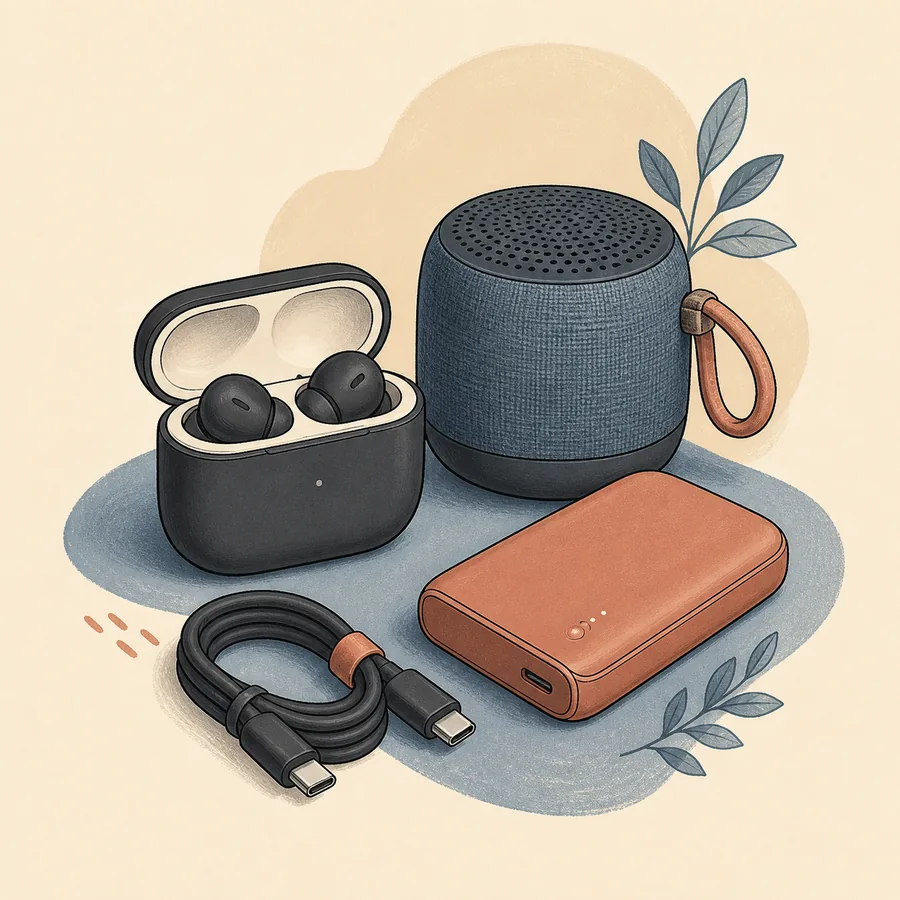
Capacity ratings, watts versus milliamp-hours, ports, cables, airline rules and what an Amazon.ca power-bank listing must tell you.
Power bank appeared in our past-90-day Canadian search-interest comparison, observed 2026-08-14, with power bank charger among the rising related queries. That is a signal we are watching, not a ranking. Power banks are also one of the easiest categories to buy badly, because the two headline numbers measure different things.
Milliamp-hours describe the tank, watts describe the tap
A stated capacity such as 10,000mAh tells you roughly how much energy is stored. A stated output such as 45W tells you how quickly it can deliver that energy. A high capacity with a low output charges a lot, slowly. A modest capacity with a high output charges a little, quickly. Decide which you actually need before comparing models.
- Rated capacity is measured at the cell voltage, so real delivered charge is always lower than the headline figure. Expect losses; the listing rarely quantifies them.
- Check whether the stated wattage is per port or shared across all ports at once.
- If you charge a laptop, confirm the listing states a wattage high enough for it and a USB-C port that supports it.
Ports and cables are listing facts, not assumptions
Never infer ports from a product photograph. The listing text and specification table are the only places to confirm them.
- Count the ports and note the type of each: USB-C, USB-A, or a built-in cable.
- Confirm which port supports the fast-charging figure, and whether it works for input as well as output.
- Check whether any cable is included, and which one. Many listings include a short charging cable only.
Size, weight and how you will carry it
- Compare the stated dimensions against the pocket or bag pouch you actually use.
- Note the stated weight; a 10,000mAh unit and a 20,000mAh unit differ meaningfully in the hand.
- If it lives in a backpack all term, prefer a case-friendly shape over the thinnest option.
Air travel and safety
Lithium batteries have carriage rules. In Canada, spare lithium batteries and power banks generally travel in carry-on baggage, not checked baggage, and airlines apply watt-hour limits. Check the current rules with your airline and the Canadian Transportation authorities before you fly — do not rely on a product listing for that.
- Look for a stated watt-hour rating, or the information needed to work it out, if you fly often.
- Look for stated safety certifications and over-charge or over-temperature protection.
- Store and charge the unit away from bedding and other flammable materials.
Warranty and support
- Check the stated warranty length and whether it is honoured in Canada.
- Check the seller as well as the brand, since support routes differ.
- Keep the order record; warranty claims usually need it.
What we hold
We hold one power-bank record: the INIU Ultra Mini portable charger with a stated 10,000mAh capacity and a stated 45W charging specification, checked against Amazon.ca search results on 2026-08-14. We state only those title facts — we have not inferred its ports, its included cables or its device compatibility. Confirm all of that on the listing.
Selected picks from this guide
An INIU portable charger with a stated 10,000mAh capacity and a stated 45W fast-charging specification. Ports, cables and device compatibility should be confirmed on the Amazon.ca listing.
Last verified Aug 14, 2026
Keep reading
- Smart Tech & Travel Essentials for Canadians: Practical Picks That Earn Their Place
How to judge value on Amazon.ca before you buy — streaming sticks, European plug adapters, power banks, digital luggage scales and surge-protected power bars, with the criteria behind each pick.
- How to choose an air fryer
What to read on an Amazon.ca air-fryer listing before you buy: usable capacity, footprint, basket material, cleaning, power draw and warranty.
- Back-to-school shopping checklist
A practical order of operations for the back-to-school stretch, with the listing details worth checking on lunch boxes, backpacks, batteries and charging gear.
As an Amazon Associate I earn from qualifying purchases.